
If you are experiencing ongoing digestive symptoms and are concerned about possible parasites, this page explains common symptoms, how testing works, and how to learn more about laboratory testing options.

As seen on
Health Uncensored
with Dr Drew

PCR-Based detection
Used by clinical laboratories

FDA-Cleared test
performed by laboratory professionals
For diagnostic laboratories:
Learn about our molecular testing workflow and parasite detection solutions.
Could I have a parasite infection?
Gastrointestinal (GI) parasites can cause a wide range of digestive symptoms and may lead to persistent illness that can be difficult to diagnose.
Common symptoms may include persistent diarrhea, stomach cramps, bloating, nausea and fatigue. Because these symptoms can overlap with other digestive conditions, laboratory testing is often needed to determine whether parasites are present, and to identify the type of parasite infection to support appropriate patient management.

Persistent Diarrhoea

Stomach Cramps

Ongoing Bloating

Nausea

Fatigue
Not all infections cause obvious symptoms
Some people infected with gastrointestinal parasites may experience ony mild symptoms, or none at all, making infections difficult to detect without laboratory testing. Asymptomatic carriers can also unintentionally spread parasites to household contacts or in community settings. Testing close contacts helps to uncover silent cases and prevent further infection.
Real Patient Experience:
The impact of an undiagnosed gastrointestinal parasite infection
Susanne first assumed she had a simple case of food poisoning when she suddenly became violently ill. What followed was six months of persistent nausea, weightloss, and overwhelming fatigue - that left her without answers.
In this video, Susanne describes the impact of this journey before finally receiving a diagnosis of Giardia infection through accurate laboratory PCR testing.
Her experience highlights why access to reliable, sensitive testing for gastrointestinal parasites is essential for improved patient care.
Following her diagnosis, Susanne received appropriate treatment for Giardia infection and made a full recovery.
Susanne’s story: living with an undiagnosed Giardia infection
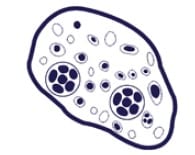
Common GI parasites include:
Click the parasites to learn more.






How modern testing for gastrointestinal parasites works
Traditional testing for gastrointestinal parasites often relies on microscopy, where parasites and their ova are visually identified in stool samples. However, as many parasites shed intermittently, they may not appear in every specimen, limiting the reliability of a single test. Test sensitivity can be as low as 50%, from a single stool sample - meaning half of infections can be missed.
In addition, parasite testing by microscopy often require specific staining techniques and highly experienced laboratory staff to accurately identify an infection.
Genetic Signatures' clinical laboratory partners overcome this challenge by employing our EasyScreen™ molecular PCR solution for accurate detection of 8 leading gastrointestinal parasites in a single test.
Genetic Signatures' molecular PCR testing solution

Highly Sensitive
Detects parasite DNA in stool

Expansive Coverage
Detects 8 leading gastrointestinal parasites in a single test

Accurate & Reliable Testing
Consistent laboratory results
Genetic Signatures' test screens for 8 gastrointestinal parasites.
- Uses PCR technology, the gold standard of laboratory testing
- Provides faster test results and higher sensitivity and accuracy than conventional tests
- Backed by leading diagnostic laboratories and public health networks
Identification of these parasites allows clinicians better manage your health and reduce the chance of further spread of disease, and outbreaks.
Detect with confidence
Clinical Performance: Precision-Tested PCR testing for gastrointestinal parasites
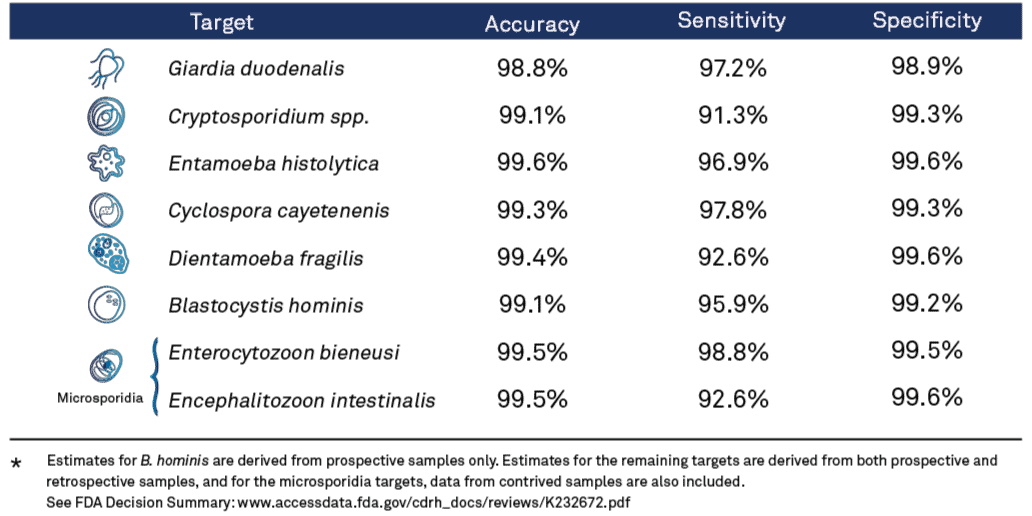
Genetic Signatures FDA 510(k) cleared EasyScreen™ Gastrointestinal Parasite Detection Kit and automated workflow was evaluated in clinical studies submitted to the FDA as part of the 510(k) clearance process.
Tested across all eight parasite targets, the assay demonstrated an overall accuracy of 99%, with high sensitivity and specificity for each individual target.
Full performance data is available in the package insert and FDA 510(k) summary at accessdata.fda.gov.
How parasite testing works



A healthcare provider will ask you to provide a stool sample.
The sample is sent to a clinical laboratory where molecular PCR testing can detect up to 8 parasites in a single test. This involves purifying all DNA present in the sample before PCR testing is used to detect the presence of any DNA known to be from a gastrointestinal parasite. If parasite DNA is found, the laboratory reports a positive result.
Results are sent to your healthcare provider to help guide diagnosis and treatment.
How can we help you?
Detect with precision. Treat with confidence. Genetic Signatures' powerful solution for GI parasite testing.

Concerned about parasite symptoms?
If you are experiencing ongoing digestive symptoms, speak with your healthcare provider.
We can help you to connect with our clinical laboratory partners offering our unique parasite testing solution.

For diagnostic laboratories
Discover how our FDA 510(k)-cleared automated molecular workflow empowers laboratories to detect 8 parasites from a single sample - delivering faster results, higher accuracy, and greater testing efficiency.

For healthcare professionals
Connect with your closest clinical laboratory offering Genetic Signatures’ molecular testing for gastrointestinal parasites.
Frequently Asked Questions
Want more information about parasite testing?
Submit the form below and we can help connect you with laboratories that may offer parasite testing.

Understanding parasite symptoms and testing
Parasites such as Giardia, Cryptosporidium, and Entamoeba histolytica can cause symptoms including persistent diarrhea, stomach cramps, and fatigue. Because these symtpms overlap with other digestive conditions, laboratory testing is often required to confirm infection. Modern molecular tests used by clinical laboratories can detect multiple parasites from a single stool sample.